5-Year CD rates in 2026: Is a 5-year CD worth it?





Historically, savers have had two good reasons for choosing a 5-year certificate of deposit (CD): rate stability and higher interest rates than shorter-term CDs. In today’s environment, one of those reasons is missing.
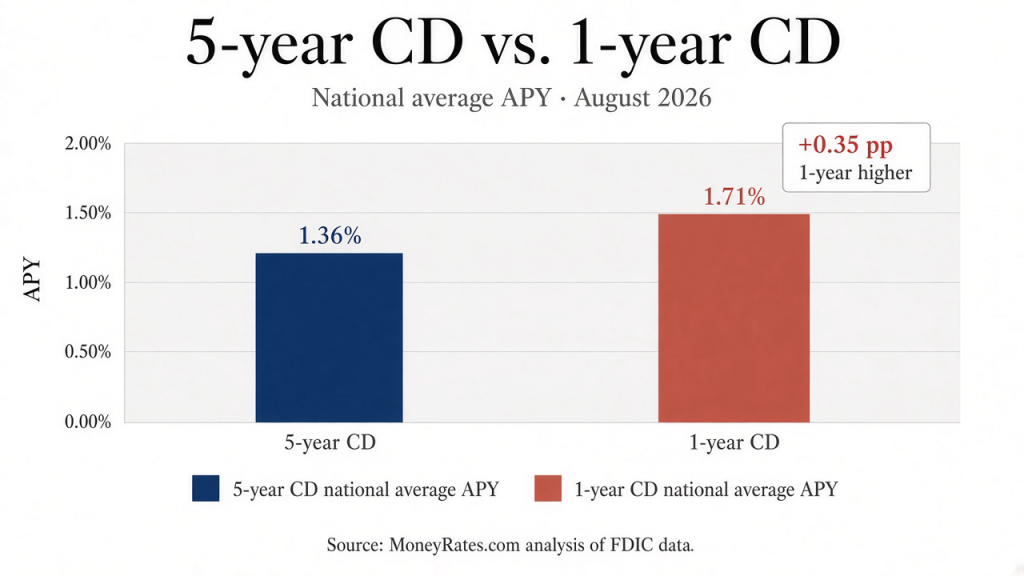
While long-term CD rates have usually been higher than shorter-term CD rates, that hasn’t been the case over the past few years. According to national rate averages published by the Federal Deposit Insurance Corp. (FDIC), as of August 2026, the 1-year CD rates were 0.35 percentage points higher than 5-year CD rates.
This leads to a natural question: without the usual rate advantage, are 5-year CDs worth it?
The answer may still be yes in some situations. Certainly, today’s rate environment requires savers to rethink how they choose CDs. However, in doing so, they may find that 5-year CDs can still be an appropriate choice.
Is a 5-year CD still worth considering in 2026?
Under normal circumstances, one reason to choose a 5-year CD is simple: they may pay higher interest rates than shorter-term CDs. However, these are not normal circumstances.
The FDIC publishes CD rate data going back to 2009. Based on year-end rate data, 5-year CDs have paid an average of 0.40 percentage points more than 1-year CDs since then. Today, though, things are different. This chart of 5-year CD vs. 1-year CD rates shows how longer-term CDs have lost their rate advantage:
So, given the relatively lower 5-year CD rates in 2026, are 5-year CDs worth it?
Despite the current rate disadvantage, the answer may still be yes, for a variety of reasons. These include expectations for where rates could go over the next five years, based on Federal Reserve policy and other economic factors. Your choice of a CD term also depends on your needs and what other investments you already have.
What 2026 Fed policy means for 5-year rates
The Federal Reserve does not directly control CD rates. However, its rate decisions do have some influence on those rates. Perhaps more significantly, Fed rates react to many of the same factors that CD rates do.
For example, current Fed policy provides a clue as to why 5-year CD rates have fallen below 1-year CD rates.
The current Fed rate outlook
The Fed raises interest rates to slow inflation. When inflation isn’t a problem, the Fed can lower rates to encourage economic growth.
Inflation soared when the economy reopened following pandemic lockdowns, and the Fed raised rates in response. When inflation began to ease, the Fed was able to lower rates in 2024 and 2025.
The Fed’s latest economic projections show it expects inflation to continue to ease over the next few years. The Fed also expects it will continue to cut interest rates in response to that easing inflation.
This expectation of falling interest rates over the next few years helps explain why 5-year CD rates are currently lower than 1-year CD rates. After all, if rates are supposed to fall, banks don’t want to be locked into paying today’s rates for the next five years.
What could cause the Fed to change course?
A lot of analysis goes into the Fed’s economic projections, but they don’t have a crystal ball. Those projections are sometimes wrong.
The Fed’s plan to lower rates depends in part on inflation easing. However, inflation has a way of being stubborn. For example, after bottoming out at 2.3% in April 2025, inflation not only stopped falling but started going in the other direction. The latest year-over-year reading of the Consumer Price Index, through July 2026, showed a 3.4% increase.
Tariffs and geopolitical conflict could add to inflation pressures. If inflation remains elevated, the Fed may not be able to lower rates as quickly as projected.
This possibility should be of concern for CD savers. The average 5-year CD rate is 1.36%. If inflation remains at 3.4%, locking in today’s average 5-year CD rate would mean earning a negative inflation-adjusted return. However, like all economic scenarios, this outcome is not a sure thing.
When locking in a 5-year CD rate can make sense
Because economic outcomes are uncertain, there are situations in which a 5-year CD can make sense even with longer-term rates being lower than 1-year rates:
Your savings goal is at least five years away
One basic condition for considering a 5-year CD should be that you won’t need the money for five or more years.
Drawing money out of a CD before its term is up typically involves paying a penalty. So, you shouldn’t consider a 5-year CD unless you’re fairly confident that you won’t need the money sooner. This means that your planned use for the money shouldn’t be within the next five years, and ideally, you should have other resources to turn to if a financial emergency arises.
You value rate certainty over near-term flexibility
Another reason to choose a 5-year CD is if you want to lock in a rate for that long.
CDs are subject to reinvestment risk. This is the risk that when the CD matures, you’ll have to reinvest the money at a lower interest rate. You face CD reinvestment risk if interest rates fall. The shorter the CDs you choose, the more often you’ll face this risk.
So, if a 5-year CD rate lock appeals to you more than the desire to access your funds sooner, you may consider a 5-year CD. 1-year rates may be higher at the moment, but if CD rates fall sharply, you would face having to reinvest the money at a much lower rate for the remainder of the five years.
You need to fill the long-term end of a CD ladder
A CD ladder strategy involves owning a series of CDs that mature at different times. Doing this gives you liquidity at regular intervals without facing the risk of having to reinvest all your savings at once.
If you’re using a CD ladder and don’t own a CD that matures in five years, a 5-year CD could make sense to complete that ladder.
When a 5-year CD may not be the right fit
While there are a variety of reasons for considering a 5-year CD, there are also situations in which one might not be the best idea.
You have nearer-term needs for the money
Since CDs involve a penalty for taking out money before their term is up, a 5-year CD is probably not a good idea if you’re going to need the money sooner than that.
You are concerned that rates might rise
Locking in a rate for a longer time is a strategy that pays off if interest rates fall. On the other hand, if rates rise, owning a longer-term CD would leave you locked into a lower rate.
So, if you think interest rates are more likely to rise than fall, you might consider a shorter-term CD. This would give you the opportunity to reinvest at a higher rate sooner.
Your CD ladder already has the 5-year slot filled
You should evaluate any potential CD in terms of how it fits with other CDs you already have. For example, if your strategy is to ladder CDs and you already have one that matures in five years, adding a new 5-year CD might be redundant.
In that case, you should look to see if there are timing gaps elsewhere in your CD ladder. If not, you might consider spreading the new deposit into CDs that mature at different times to add funds throughout your ladder.
5-year CDs and alternatives
You can be most confident in your choice of a 5-year CD once you’ve also considered alternatives, such as those described below:
Shorter-term CDs
The rate advantage 1-year CDs currently have over 5-year CDs is unusual and creates an added reason to consider a 1-year CD. You might also consider a shorter-term CD if you have financial needs coming up sooner than five years, or if you think interest rates are likely to rise.
A CD ladder
By spreading deposits across CDs that mature at different times, a CD ladder hedges the risk of having to reinvest your CD at any one time. This is one way of coping with economic uncertainty.
5-year Treasury securities
Treasury securities are an intriguing alternative to CDs if you understand the pros and cons.
Like FDIC-insured CDs, Treasury notes are backed by the full faith and credit of the U.S. government. They also have fixed maturities.
On the plus side, Treasuries currently offer yields that are higher than CD rates. A drawback is that Treasury securities fluctuate in value depending on market conditions.
Treasury prices go up when interest rates fall and go down when rates rise. Their face value is paid at maturity, but in the meantime, you could get less than you paid for the security if you sell before the maturity date. This type of decline in value could exceed the early withdrawal penalty you’d pay for accessing a CD early.
The following table summarizes the characteristics of 5-year CDs and their alternatives:
| Factor | 5-year CD | 1-year CD | CD ladder | 5-year Treasury |
|---|---|---|---|---|
| Rate lock | Five years | One year | Varies, depending on the components of the ladder | Interest payments are locked, though the yield varies with price fluctuations |
| Access | Early access typically requires paying a penalty | Access without an early withdrawal penalty at maturity | Partial access at regular intervals based on the structure of the ladder | Can be sold before maturity, but the market price may be higher or lower than the purchase price |
| Reinvestment risk | Low during the five-year term | Higher, with full reinvestment required after just a year | Spread across multiple maturity dates, with reinvestment occurring at various times | Low during the five-year term |
| Safety | Eligible deposits may be FDIC- or NCUA-insured, subject to applicable coverage limits | Eligible deposits may be FDIC- or NCUA-insured, subject to applicable coverage limits | Eligible deposits may be FDIC- or NCUA-insured, subject to applicable coverage limits | No deposit insurance, but face value guaranteed by the U.S. government if held to maturity |
How to evaluate a 5-year CD before opening one
Here are some steps to take when deciding whether a 5-year CD is right for you:
- Think ahead about when your financial needs will occur to figure out if you can afford to wait five years.
- Shop around for the best 5-year rates you can find.
- Compare 5-year rates with rates for other CD terms to see how big an advantage or disadvantage 5-year CDs offer.
- Consider whether interest rates are likely to rise or fall over the next few years.
- Compare rates with the current rate of inflation to determine the inflation-adjusted return.
- Check for FDIC or National Credit Union Administration (NCUA) insurance on the CD you’re considering.
- Research any other terms or conditions, such as the CD’s early withdrawal penalty.
Even if they don’t offer their usual rate advantage at the moment, 5-year CDs are still worth considering under some circumstances. Just be sure to make the choice thoughtfully, since you’ll be locked into it for the next five years.
Frequently asked questions about 5-year CDs
In most cases, yes. There are variable-rate CDs, though they are less common than fixed-rate CDs. Before choosing a CD, be sure to check whether the rate is fixed or variable.
If it’s a fixed-rate CD, you’ll continue to earn the same interest rate whether rates rise or fall after you open it.
The 5-year CD early-withdrawal penalty is usually based on a stated time period’s worth of interest. These penalties vary from bank to bank, so be sure to check the penalty when choosing a CD.
Generally, yes. Even though you can’t access the money in the CD for five years without a penalty, interest is earned throughout the CD’s term. CD interest is generally taxable in the year it’s credited to your account and available for withdrawal. Plan ahead to make sure you’ll have enough cash available to pay those taxes.