Why are short-term CD rates higher than long-term rates?





CD rates don’t always follow the pattern savers might expect. Sometimes, short-term CDs offer higher rates than longer-term CDs.
As of September 2026, average CD rates offered by U.S. banks showed what’s known as an inverted rate curve. That means the normal shape of the CD yield curve is upside down.
Most of the time, longer-term CDs pay higher interest rates than short-term CDs. However, that relationship flipped at the beginning of 2023. Based on average bank rate data from the Federal Deposit Insurance Corp. (FDIC), that’s when 1-year CDs started offering higher rates on average than 5-year CDs. This inverted CD rate curve remained in place as of September 2026.
For bank customers who are used to seeing longer-term CDs offer higher rates, this inverted CD rate curve may seem confusing. It’s important to understand some of the reasons behind these conditions and the risks involved before you choose your next CD.
Why can short-term CD rates be higher than long-term rates?
CDs normally involve a trade-off: in return for locking up your money for a longer time, you can earn a higher interest rate. Generally speaking, it’s worth more to a bank to have a customer’s deposits locked into a CD for a longer time. So, they’re willing to pay more interest on longer-term CDs. From the customer’s point of view, that higher interest is the reward for giving up the flexibility to move their money out of the CD sooner.
What an inverted CD rate curve looks like
The FDIC has data on the average CD rates offered by U.S. banks going back to 2009. Based on the average year-end rates since then, here’s what the relationship between short-term rates and long-term rates has typically looked like:
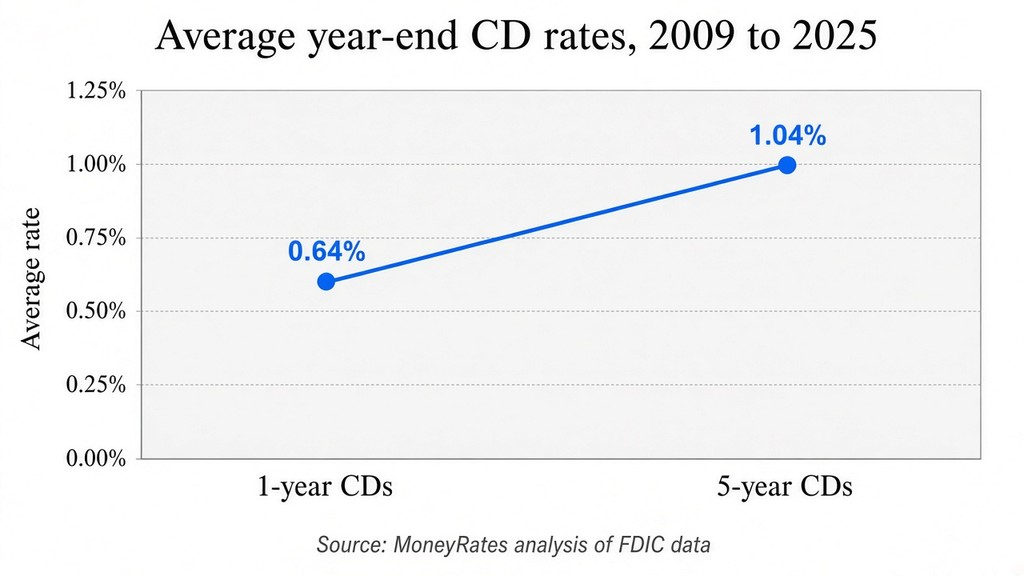
On average, as you move from short-term CD rates to long-term CD rates, banks have offered higher interest rates. The shape of the line formed when you graph this relationship is known as the CD yield curve.
Under normal circumstances, this curve tilts upwards, since long-term rates are generally higher than short-term ones. However, things are very different now:
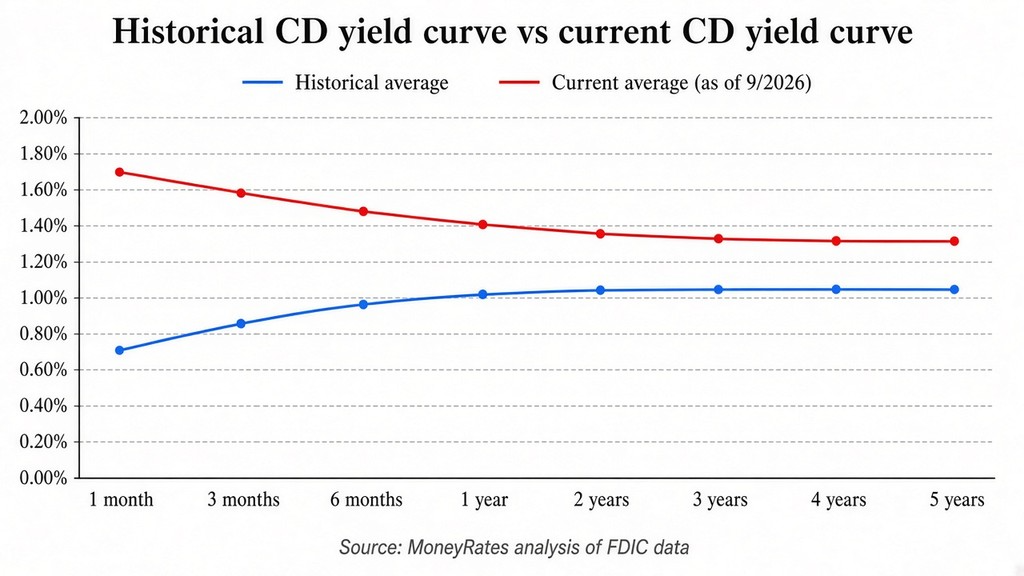
The blue line shows the same historical CD yield curve from the earlier chart. The red line shows the current CD yield curve.
As you can see, the normal relationship of short-term CD rates vs. long-term CD rates has flipped. Short-term CDs currently offer higher interest rates on average than long-term CDs. The red line is an example of an inverted CD rate curve.
How can this happen? Inverted yield curves may be the exception, but they do occur. There are a variety of factors at play, including inflation, Federal Reserve policy, and the business strategy of banks’ funding and pricing strategies. The pattern isn’t universal, however. Individual banks may price CD terms differently based on their own funding needs and competitive strategies.
The next section looks at some examples of what can lead to an inverted CD rate curve.
Four forces that can push short-term CD rates above long-term rates
The following are some possible explanations for why 1-year CDs pay more than 5-year CDs from time to time:
Current Federal Reserve policy supports short-term rates
The relationship between the Federal Reserve and CD rates is indirect; that is, the Fed doesn’t directly control CD rates. However, it does have some control over what it costs banks to borrow money for their needs. Banks can also get funds from customer deposits. The higher the federal funds rate is, the more banks may be willing to pay customers for deposits like CDs.
When the economy reopened after the worst of the pandemic, inflation around the globe surged. In the U.S., year-over-year inflation peaked in mid-2022 and then started to fall.
The Fed raised interest rates in response to the post-pandemic surge of inflation. Once it appeared that the threat from inflation had started easing, the Fed started lowering interest rates in 2024 and 2025. Based on its latest economic projections, the Fed expects the federal funds rate to decline over the next few years, though that’s by no means a sure thing.
This means the Fed policymakers’ projections currently show lower policy rates in future years. Those expectations can contribute to a rate environment in which short-term CD rates exceed longer-term rates.
Banks may expect interest rates to be lower in the future
To some extent, banks’ expectations for CD rates are based on the same factors as the Fed’s expectations. If inflation continues to fall, CD rates may come down over time.
Longer-term rates can reflect expectations about the path of short-term rates over the CD’s term. If banks expect those rates to decline, they may be less willing to guarantee today’s comparatively high rate for several years. From that perspective, it makes sense that 1-year CD rates may be higher than 5-year rates.
Banks may need deposits for a specific period
Banks use customer deposits to fund business activities such as lending and investments. The timing of those activities may vary, and the resulting bank funding needs can be reflected in the CD rate curve.
If banks have an immediate need for funding, they may offer a higher rate for short-term CDs to attract deposits. When banks are taking a longer-term perspective, they may be more interested in locking up deposits in longer-term CDs.
Promotional offers can distort the normal rate pattern
Banks also use CD rates to try to grow their business. A high CD rate can make for an attractive advertising campaign. Banks know that customers search sites like MoneyRates.com to find the highest rates, so they might offer special promotions to make their CD rates rank higher than those offered by their competition.
However, if a bank is offering a special promotional rate to attract attention, it may not want to be locked into paying that high rate for years to come. That’s why a bank might use relatively short-term CDs for these promotions. That can cause its short-term rates to look unusually high compared with its long-term ones. Before opening a promotional CD, check the eligibility requirements, minimum opening deposit, and what happens when the CD matures or renews.
How long can an inverted CD rate curve last?
Of the 17 year-end sets of CD rates available from the FDIC, the CD rate curve has been inverted for only three of them. That shows how unusual today’s conditions are. So how long can we expect this to continue?
The answer is uncertain because future economic developments are unknown. However, history can give some guide to what can happen, and there are also clues you can look for to see if the relationship between long-term and short-term CD rates may be changing.
Historical perspective
The CD rate data only goes back to 2009, but you can get a longer-term perspective on inverted rate curves by looking at U.S. Treasury yields.
Treasury yields are affected by many of the same factors as CD rates. They tend to rise when inflation is rising and fall when inflation eases. As with CD rates, long-term Treasury rates are normally higher than short-term ones, but sometimes this relationship inverts.
In over 70 years of bond yield data from the Federal Reserve, there have been only 10 occasions when 1-year Treasury yields have been higher than 5-year yields for six months or more. The longest of these occurrences was 29 months, beginning in July 2022.
This history of Treasury yields shows that sustained inversions have been relatively uncommon. While Treasury yields showed an inverted rate curve in recent years, they have since returned to a more normal relationship, with 5-year yields exceeding 1-year yields.
Signals that the CD rate gap may be changing
The fact that Treasury yields have returned to a more normal rate curve may be one sign that conditions are changing. This could lead to CDs following suit, with 1-year CD rates eventually falling below 5-year CD rates.
If you want to monitor this, it’s hard to tell what’s going on industry-wide just by looking at a specific bank’s CD rates. After all, there are thousands of banks, and CD rates vary greatly among those institutions. However, the FDIC website publishes monthly rate averages on CDs and other bank products. These can help you keep an eye on rate trends.
Besides checking to see if 5-year CD rates nationally have moved above 1-year CD rates, you can also see whether the gap between them is widening or narrowing. That can tell you whether the inverted rate curve is becoming more pronounced or disappearing.
Another clue to the future of the inverted rate curve may be found in periodic economic projections released by the Federal Reserve. These reflect projections from participants of the Federal Open Market Committee. That’s the group that votes on interest rate decisions.
Those economic projections are updated by the Fed four times a year. They show where participants project the federal funds rate may be at the end of each of the next few years. Currently, the projections show a lower median federal funds rate in the years ahead. As long as that’s the case, it provides one reason 5-year rates may continue to be lower than 1-year rates. However, changes in these projections could indicate the expectations for future rates are shifting.
Does a higher short-term APY make a short-term CD the better choice?
Just because 1-year CDs are offering higher rates than 5-year CDs, that doesn’t necessarily make them a better choice.
Shorter-term CDs subject you to more reinvestment risk. This is the risk of having to reinvest your money at a lower rate. The shorter the term of the CD, the more often you face this risk. Locking in a CD rate for a longer term allows you to reduce this risk.
This trade-off largely comes down to the size of the gap between short-term and long-term CD rates. If short-term CDs are offering significantly higher rates, it might be worth accepting more reinvestment risk. However, if the rate gap is narrow and conditions suggest rates might be falling, you may prefer to lock in today’s rate for a longer term.
The following table summarizes some of the trade-offs involved in choosing between a short-term and a long-term CD when the rate curve is inverted:
Decision trade-offs when the CD rate curve is inverted
| Factor | Higher-rate short-term CD | Lower-rate long-term CD |
|---|---|---|
| Initial APY | May be higher if rate curve is inverted | May be lower if rate curve is inverted |
| Rate-lock period | Shorter | Longer |
| Reinvestment risk | Higher | Lower until maturity |
| Access to funds without penalty | Sooner | Later |
| Early-withdrawal exposure | Shorter commitment | Longer commitment |
Choosing a CD when short-term rates are higher
Here are some tips for choosing a CD when short-term rates are higher:
- Assess your needs. Consider when you’ll need the money, the early withdrawal penalty, and how long you’re comfortable locking in the rate.
- Shop around. Rate conditions vary from one bank to the next, so find the best CD rates you can before you make a decision. Also compare minimum deposits, early withdrawal penalties, automatic renewal terms, and grace periods.
- Consider the gap. The size of the gap between short- and long-term CD rates could affect how you weigh other factors.
- Evaluate rate trends. Factors such as the Federal Reserve’s economic projections and whether inflation seems to be accelerating or slowing may affect how you weigh current rates against reinvestment risk.
- Look into a CD ladder. A range of CDs with different maturity dates can spread out reinvestment risk.
Inverted rate curves are unusual. As long as they exist, they are one factor to consider when choosing a CD.
Frequently asked questions about inverted CD rates
No. An inverted curve may mean bankers and economists expect rates to fall, but it doesn’t guarantee that they will.
A bank may be willing to offer a higher rate to attract customers, but it may not want to commit to that higher rate for longer terms.
Not necessarily. You have to weigh the rate advantage against reinvestment risk and your needs when choosing a CD term.
Yes. Rates offered on newly opened short-term CDs can fall before your CD matures, but if you have a fixed-rate CD, the rate you’re getting generally won’t change until the CD matures.